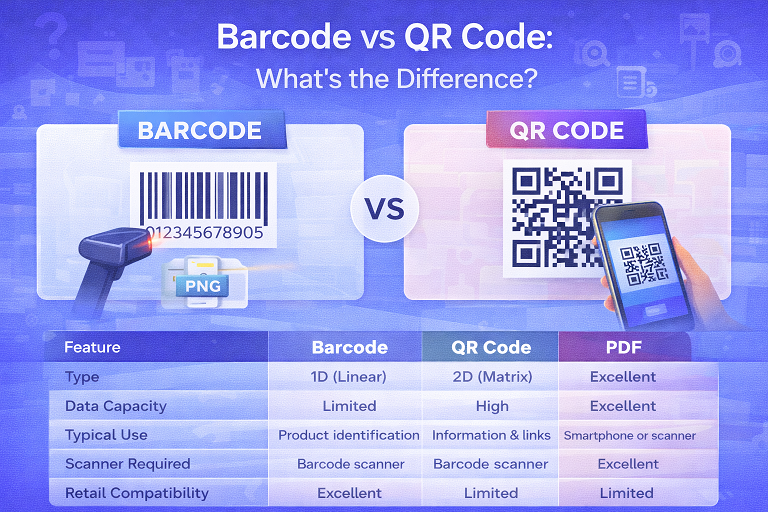
Barcode vs QR Code: What’s the Difference?
Barcodes and QR codes are everywhere — on product packaging, shipping labels, restaurant menus, and marketing materials. While they may look similar, they serve different purposes.
In this article, we’ll explain the key differences between barcodes and QR codes, how each one works, and which option is best for your business.
What Is a Barcode?
A barcode is a one-dimensional (1D) code made up of vertical lines and spaces. It represents a numeric or alphanumeric product identifier that is read by barcode scanners.
Common barcode types include UPC and EAN, which are widely used in retail and inventory systems.
How Barcodes Are Used
- Retail checkout and point-of-sale systems
- Inventory tracking and stock management
- Warehouse and logistics operations
- Product identification
What Is a QR Code?
A QR code (Quick Response code) is a two-dimensional (2D) code made up of small squares arranged in a grid. It can store much more information than a traditional barcode.
QR codes are designed to be scanned quickly, often using smartphones and mobile devices.
How QR Codes Are Used
- Website links and digital content
- Marketing and promotions
- Contact information and payments
- Menus, tickets, and authentication
Key Differences Between Barcodes and QR Codes
| Feature | Barcode | QR Code |
|---|---|---|
| Type | 1D (Linear) | 2D (Matrix) |
| Data Capacity | Limited | High |
| Typical Use | Product identification | Information & links |
| Scanner Required | Barcode scanner | Smartphone or scanner |
| Retail Compatibility | Excellent | Limited |
Can QR Codes Replace Barcodes?
In most retail environments, no. Traditional barcodes are still the standard for checkout, inventory systems, and retail compliance.
QR codes are excellent for sharing information, but they are not commonly used as primary product identifiers in retail stores.
When Should You Use a Barcode?
- You sell physical products
- You need retail or POS compatibility
- You want reliable inventory tracking
- You sell through warehouses or distributors
When Should You Use a QR Code?
- You want to link to websites or digital content
- You run marketing or promotional campaigns
- You need to store detailed information
- You want easy smartphone scanning
Using Barcodes and QR Codes Together
Many businesses use both barcodes and QR codes on the same product. The barcode is used for retail and inventory, while the QR code provides extra information for customers.
This combination offers the best of both worlds — operational efficiency and enhanced customer engagement.
Final Thoughts
Barcodes and QR codes serve different purposes. Barcodes are essential for retail and inventory systems, while QR codes are powerful tools for sharing information.
Choosing the right option depends on how and where you plan to use the code. Understanding the difference helps you make better decisions for your products and business.
 Buy Barcode in Multan
  Buy Barcode in Abbottabad
  Buy Barcode in Sialkot
  Buy Barcode in Sukkur
  Buy Barcode in Lahore
  Buy Barcode in Peshawar
  Buy Barcode in Rawalpindi
  Buy Barcode in Faisalabad
  Buy Barcode in Gujranwala
  Buy Barcode in Rahim Yar Khan
  Buy Barcode in Larkana
  Buy Barcode in Bahawalpur
  Buy Barcode in Sheikhupura
  Buy Barcode in Gujrat
  Buy Barcode in Hyderabad
  Buy Barcode in Quetta