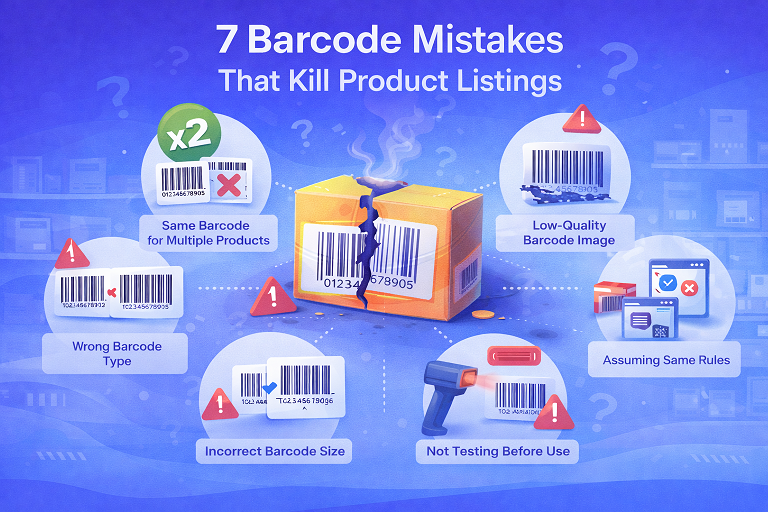
7 Barcode Mistakes That Kill Product Listings
Barcodes may look simple, but using them incorrectly can lead to serious problems — including rejected product listings, scanning failures, and lost sales.
Many sellers don’t realize they’ve made a mistake until their product is already live or rejected by a retailer or marketplace. In this article, we’ll break down the 7 most common barcode mistakes that can quietly kill your product listings — and how to avoid them.
1. Using the Same Barcode for Multiple Products
One of the biggest barcode mistakes is reusing the same barcode for more than one product. Each product — including size, color, or variation — must have its own unique barcode.
Reusing barcodes can cause inventory confusion, incorrect product data, and listing rejections on marketplaces.
2. Choosing the Wrong Barcode Type
Not all barcodes are the same. Using the wrong format, such as choosing a UPC when an EAN is required (or vice versa), can lead to compatibility issues.
Always check whether your selling platform or target market prefers UPC, EAN, or another barcode format.
3. Low-Quality Barcode Images
Blurry, stretched, or pixelated barcodes often fail to scan properly. Poor print quality is a common reason for checkout errors and rejected packaging.
Always use high-resolution barcode files and the correct format (such as PNG, SVG, or PDF) for printing and packaging.
4. Incorrect Barcode Size
Barcodes that are printed too small or too large may not scan reliably. Size matters when it comes to barcode readability.
Follow recommended barcode size guidelines and test your barcode before mass printing or listing products.
5. Not Testing the Barcode Before Use
Many sellers skip testing and assume the barcode will work. This can lead to last-minute surprises at checkout or in warehouses.
Always scan your barcode using a barcode scanner or mobile scanning app before publishing your product listing.
6. Assuming All Platforms Have the Same Barcode Rules
Different marketplaces and retailers have different barcode requirements. A barcode accepted on one platform may not be accepted on another.
Before listing your product, review the barcode policies of the specific platform or retailer you are selling on.
7. Ignoring Product Variations
Each variation of a product — such as size, color, or packaging — should have its own unique barcode.
Using a single barcode for multiple variations can cause inventory mismatches, customer complaints, and listing removals.
How to Avoid These Barcode Mistakes
- Use a unique barcode for each product and variation
- Choose the correct barcode type for your market
- Use high-quality barcode image files
- Follow proper barcode size guidelines
- Test barcodes before listing or printing
- Understand platform-specific barcode rules
Final Thoughts
Barcodes play a critical role in product identification and retail success. Small mistakes can cause big problems — but they are easy to avoid with the right knowledge and preparation.
Taking a few extra minutes to set up your barcodes correctly can save you time, money, and frustration down the road.
 Buy Barcode in Sukkur
  Buy Barcode in Multan
  Buy Barcode in Peshawar
  Buy Barcode in Rahim Yar Khan
  Buy Barcode in Rawalpindi
  Buy Barcode in Sheikhupura
  Buy Barcode in Abbottabad
  Buy Barcode in Sialkot
  Buy Barcode in Sargodha
  Buy Barcode in Lahore
  Buy Barcode in Larkana
  Buy Barcode in Mardan
  Buy Barcode in Quetta
  Buy Barcode in Faisalabad
  Buy Barcode in Gujranwala
  Buy Barcode in Hyderabad